
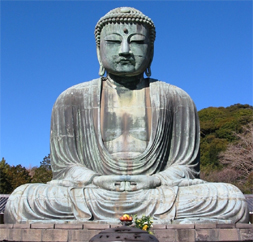
Buddhism is a religion to about 300 million people around the world. The word comes from 'budhi', 'to awaken'. It has its origins about 2,500 years ago when Siddhartha Gotama, known as the Buddha, was himself awakened (enlightened) at the age of 35.
To many, Buddhism goes beyond religion and is more of a philosophy or 'way of life'. It is a philosophy because philosophy 'means love of wisdom' and the Buddhist path can be summed up as:
(1) To lead a moral life,
(2) To be mindful and aware of thoughts and actions, and
(3) To develop wisdom and understanding.
Siddhartha Gotama was born into a royal family in Lumbini, now located in Nepal, in 563 BC. At 29, he realised that wealth and luxury did not guarantee happiness, so he explored the different teachings of the day. After six years of study and meditation, he finally found 'the middle path' and was enlightened. He spent the rest of his life teaching the principles of Buddhism—called the Dhamma, or Truth—until his death at the age of 80.
The core of Buddhism depends more on understanding than faith, and can be summed up by the Four Noble Truths:
In summary, the Noble Eightfold Path involves being moral (through speech, action, and livelihood), focusing the mind to be fully aware, and developing wisdom and compassion. The moral code is supported by the Five Precepts: to abstain from killing, stealing, sexual misconduct, untrue speech, and intoxication (which leads to a loss of mindfulness).
Karma is the law of cause and effect—that our actions have results. It underlines the importance of individuals being responsible for their past and present actions. Buddhism teaches that wisdom should be developed alongside compassion. True wisdom is not simply believing what we are told, but experiencing and understanding reality with an open, objective mind.
Courtesy of Buddha.net


Copyright Shuriway
All rights reserved.
Use of this website is governed by the Terms of Use.